
The price of broken promises.
Every era in human history is built on a myth, and every brand is built on a tale well told.
Our modern Australian story began in the post-war glow of the mid-20th century. The deal was simple: if you showed up and put in the hours, the system would back you. Individual freedom was the prize and institutional support was the foundation you jumped off. You bought a nice home on a single income, sent your kids to decent schools, and believed that, across the arc of your life, tomorrow would inherently be a touch better than today. While the ability to live this dream is coming to an end, its promise and mythology still shape our desires and decisions.
In reality it was a short-lived fifty-year period that has no precedent in human history. You could argue it really only lasted twenty years or a single generation (who are still booming round the burbs to this day). By the time the 1970s hit, bringing with it stagflation, oil shocks, and the end of the gold standard, the post war social contract was already starting to fray at the edges. In the 1990s we saw transformative technology, and the growth of free trade aided the transfer of wealth from settled prosperous companies and communities to a digital Wild West and a new manufacturing power in China. The 2000s brought the financial crisis which was really the end, as the public balance sheet bailed out the private one. In the 2020s COVID pushed state debt to levels never seen before.
We are now at a point where, instead of fixing the plumbing, we did what any overconfident culture does: we rebranded the promise. We traded tangible institutional support for the intoxicating illusion of personal freedoms, funded entirely by cheap credit and global supply chains. This era is over and our rebrand of societal freedom towards personal fiefdom is hitting the brick wall called consequence.
The wider Western world order is trapped in low economic growth, surging national debt and no longer sticky but structural inflation. For anyone who spends their days managing, building or positioning brands this macro mess is exposing a fatal flaw in how we construct value at our own micro level.
Freedom at the top, failure at the bottom
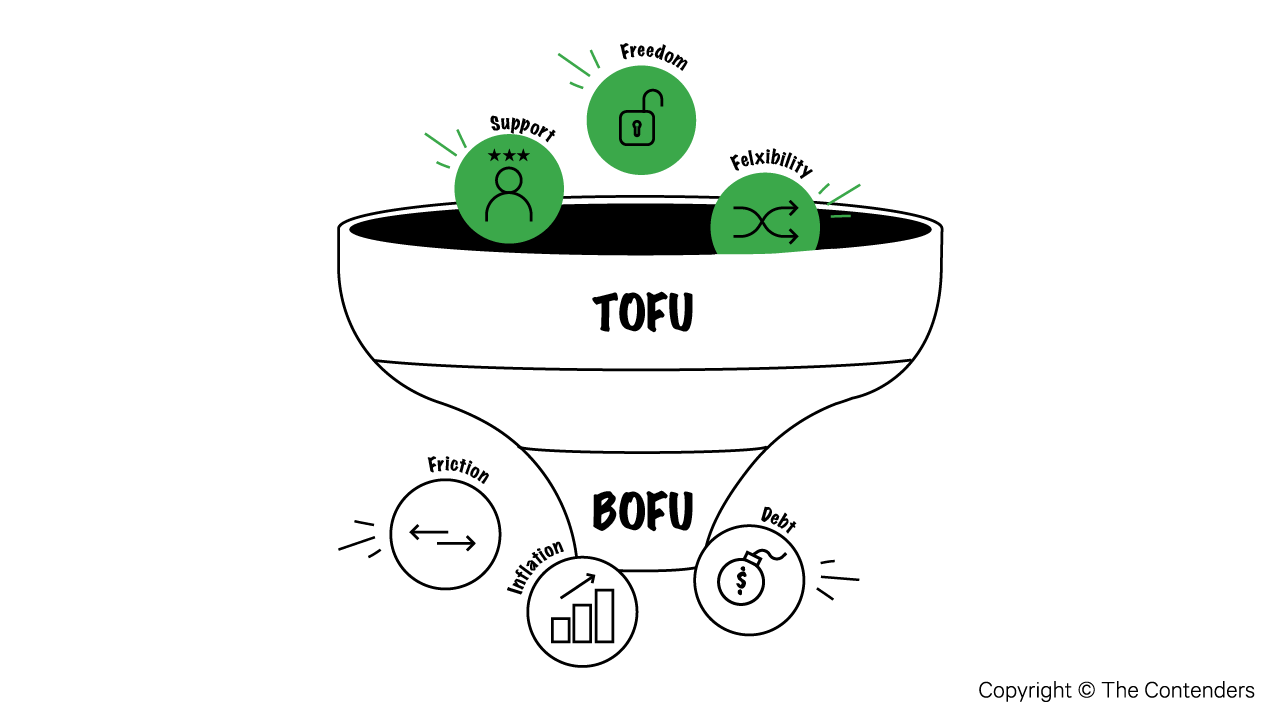
If Western society was a brand it would have serious issues in its funnel. It would present as a world-class, top-of-funnel acquisition machine aided by elite brand DBAs, punching above its weight on conversion but abysmal at bottom-of-funnel retention.
At the top of the funnel, the narrative of freedom like those of the founding of Athens and the formation of America, is irresistible. From this lofty height businesses and political leaders endlessly sell us two complementary narratives: we are free and we are supported to reach our dreams. This is very attractive but it hides a serious customer retention issue as the product being sold is out of stock.
The challenge business is waking up to is many of their brands were built to sell to a middle class lifestyle that is an anomaly in human history. The beauty of Western societies was that for a time we had three classes, not serfs and lords, nor the working class and the aristocracy, but working, middle and upper classes. You could move between the levels if you lived in line with the orthodoxy of the day. Work hard, and you move up a rung. This splintering is everywhere. Middle-market brands that are merely slightly better and nicer-feeling are drowning as the consumer either swims upstream or deep dives for the bottom.
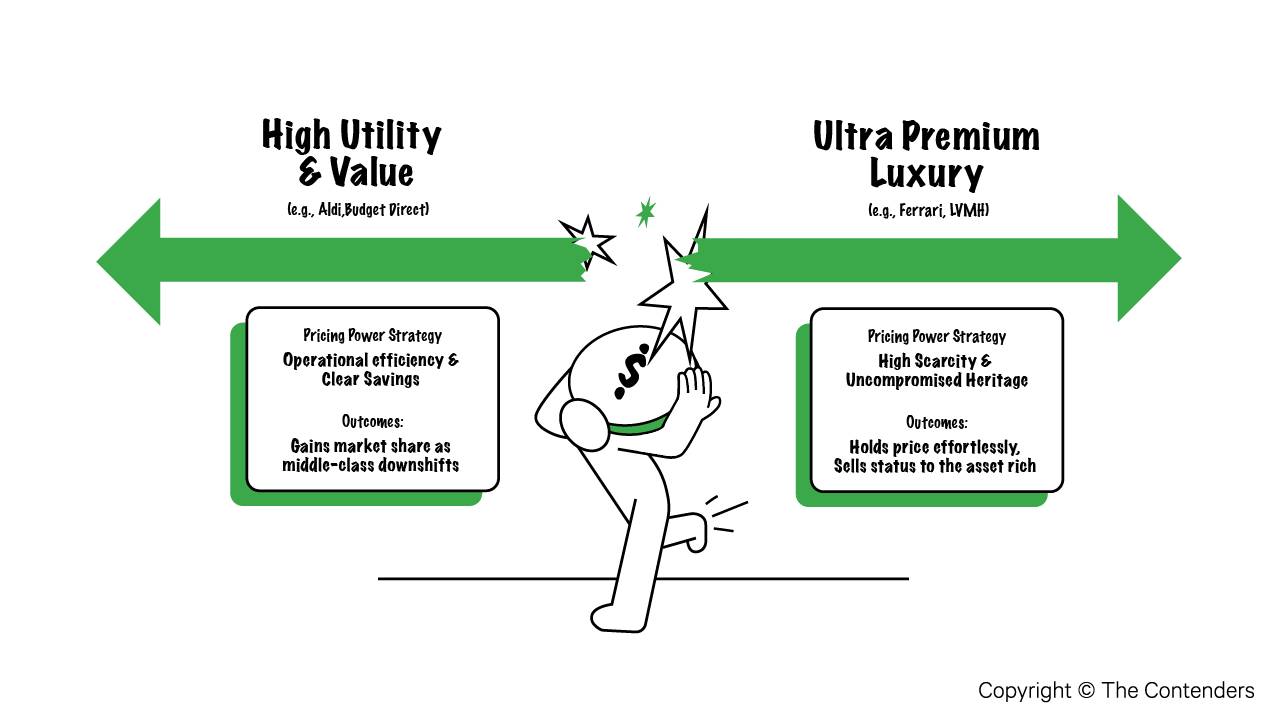
Brands targeted at the middle are being replaced by those offering one of two kinds of ROI: return on image or return on cold, hard investment. These brands are everywhere hiding in plain sight and there is not a single one that is thriving.
When a brand gets stuck in the middle, it doesn't die in a dramatic flash of fireworks; it bleeds out quietly in boardroom presentations by consultants like yours truly, trying to revive the patient. The most dangerous place to trade today is the middle tier where legacy overheads meet shrinking consumer appetite. Take VW. Volkswagen built its foundation myth on being ‘the people's car’. German engineering delivered at accessible price points. Fast forward to today, and VW is caught in a vice. On one side, Chinese EV competitors like BYD and Geely are building vehicles for half the cost using leaner supply chains. On the other side, luxury brands own the profit margins at the top.
VW is left paying heritage German factory costs for a mass-market car that is no longer cheaper or technologically superior to its rivals. Facing potential plant closures in Germany and massive global job cuts is not a proactive strategy no matter how it is spun; it is the inevitable cost of sitting in the middle for too long.
You could argue that Nike spent forty years mastering the art of achievement, attaching its swoosh to endeavours of human greatness – from Air Jordan to Serena Williams – but forgot that product is the most important P of all. Then came the digital pivot. Nike decided to chase another P, place, through DTC. While Nike was busy optimising its digital funnel, specialist brands like Hoka, New Balance and Brooks quietly stole the actual athletes. Some competitors moved higher up the value chain while others lowered prices and offered more utility. Nike's storytelling remained elite, but the bottom of the funnel delivered uninspired product iterations and premium price tags.
Closer to home, AAMI has long relied on warm, approachable storytelling. Campaigns like 'Lucky You're With AAMI' are masterclasses in mental availability and cultural likability. The problem? Insurance as a category is no longer a soft emotional purchase; it is a household budget line item under siege. Climate risk, reinsurance costs, and repair inflation have all pushed premiums up by 20% to 30% year-on-year. Turns out a nice slogan cannot fix a bottom-of-funnel affordability crisis so retention suffers.
Even Macca’s has become a mess. McDonald's built its global dominance on one simple truth: cheap, repeatable utility. This is no longer true. To protect its franchisees’ margins Macca’s has pushed menu prices up nearly 40% to cover wage and ingredient costs. Suddenly, a standard meal has pushed past $18. The moment McDonald's lost its price authority, it destroyed its actual utility. If a Big Mac costs the same as a fresh meal at a local QSR or Guzman y Gomez, the consumer stops, thinks and substitutes.
History does not happen twice
Sitting in the middle hoping for the old normal to return is not a strategy, it is an invitation to be replaced. When a brand's proposition sits in the 'unloved middle' – neither cheap enough to offer raw utility nor distinctive enough to command premium margins – it gets crushed by a life it was not built for. At the bottom of the funnel is where this dream is meeting a cold, hard reality and it is collapsing much like our roads here in Victoria. While you always have to watch for the potholes you don’t see, there are three inescapable economic realities that none of us are going to be able to swerve away from.
Sovereign and personal debt: Western nations are sitting on debt-to-GDP ratios well above 100%, while household debt piles remain near historic highs. When the cost of capital was zero, everyone looked like a genius. Now that money has a price again, servicing that debt eats the extra income that powers the discretionary economy.
Stagnant productivity: Output per hour worked across advanced economies has essentially plateaued. We didn't use the digital revolution to make work more productive; we mostly used it to make administrative tasks more complex and distraction more accessible.
Cost compression: Inflation easing doesn't mean prices fall; it just means they stop climbing quite as fast. The higher cost base established over the last five years is permanent, leaving consumers feeling permanently poorer. Prices are cheaper today than they will be tomorrow.
Focus on the other P: Pricing
In a market where consumers are pinched and debt is expensive, pricing power becomes the single truth that holds a brand together. Price is where your strategy meets reality. When input costs spike, brands with weak positioning are forced to make a terrible choice: absorb the cost and destroy their margin, or pass it on and watch their customers flee. Price is the forgotten hammer in the marketers toolbox.
The brands that are actually growing and maintaining price are those operating at the extreme ends of the spectrum that mirrors the state of our societies. On one side are high-utility, disciplined operators like Walmart or Bunnings, who deliver relentless clarity on value and time. On the other are true luxury and capability brands like Apple or R.M. Williams, who offer an emotional and functional justification so strong that substitution feels like a compromise.
If we are going to navigate the years ahead, business leaders and brand builders need to focus on escaping the middle through either dropping or raising prices. If you are choosing to lower prices, strip away the corporate fluff, optimise the supply chain, and dominate the bottom of the category through sheer efficiency and undeniable value. If you have more elevated thoughts you need to raise prices, lean into product development, lean into scarcity, and build a positioning strong enough to hold the price you believe in, not the one the category tells you is so.
—
Be better to each other.