
Big tech ate our attention. AI is hungry for something else.
My job comes down to one thing: sense-making from multiple conflicting sources. My first proper part-time job was pumping gas at a rural petrol station back home in Nova Scotia. My job was part pump jockey, part windshield cleaner but mostly the friendly local face who remembered you. I didn’t always remember their name, but I did always observe something (from the truck they drove to the hockey team they supported to the way they liked their coffee) that I could recall and use as the start of a conversation. I came to know things I wish I didn’t but also tips, tricks and tidbits I still think about to this day. I started my career as a research analyst eating sandwiches most evenings of the week watching people respond to all types of stimulus from concept statements, to colour palettes to new social policy to new product ideas.
Beyond learning to leave the sandwich and sweet tray well alone, I learned one skill that I still use every day: that observation is the art of ignoring what people say, but watching what they do. People rarely say what they mean but their behaviour always shows it. Focusing on watching the customer always guides you to better solutions even if sometimes what they do is disturbing.
I have been thinking about this over my last few months of planes, trains and far too many replacement buses. The behaviour I observe today in relation to our use of technology is different than ever before. Before COVID everyone was looking up and scanning the room to see who was watching them while they checked their feeds. Today, the social gaze has dropped entirely. We are not interested in looking for who is in the real room anymore; we are completely immersed in our pocket-sized oracles. Masked by the societal disruption of the ‘new normal’, there is a quiet migration inward. We are beginning to see a shift away from broadcasting our lives to the masses on socials to whispering our anxieties to a context engine that doesn't question us unless it is prompted to do so.
The great delusion of the social media era was that it was fundamentally about connection. It wasn't. It was about an extraction machine engineered to give you enough dopamine so it could mine your attention. Zuckerberg does not want to know your secrets; he just wanted you to look at a glass screen long enough to serve you an ad for another vanilla DTC business. That was and still is the model. Social media is a business of attention arbitrage. They aggregate attention and sell it to the highest bidder through ad networks.
Most social media is less social today than ever before, but the focus on keeping your eyes glued there remains. Social media is performative, attention seeking and arguably left an entire generation exhausted, anxious and less social than before it started. It conquered our eyeballs but it never tried to know us or speak to our souls.
From attention to intimacy
Technology has always been a pathway to monetise a business model through emotional attachment. Until technology builds itself, technology is a tool built by humanity and as such the emotional reality of humans sits at its heart. The post-war breakthrough of Broadcast TV drove comparison and the establishment of status not to class but to your next door neighbour. The mobile era brought us social media which monetised your attention. AI is already establishing a path to monetisation through a business model grounded not in attention, but in intimacy.
This is a massive shift in the economics of how money is made. The AI intimacy era is a business model of disintermediation. When a consumer trusts an AI companion to manage their inner world, in time that AI becomes the ultimate gatekeeper of their wallet. AI does not care about getting you to doom scroll through an infinite feed of small titillations. It wants something far more valuable: your vulnerability.
As we all experience we are moving rapidly from an era of searching through keywords to an era of prompting. Prompting is inherently an act of exposure. A list of my prompts since Christmas covers everything from how to fix condensation in my attic (unsuccessful) to how to lose 10kg after 50 GP1 free (so far so good) to the correct way to structure our little group of businesses here at Contenders HQ (very successful).
When you ask a GPT to help you draft a difficult email or format a plan to fix your life, you aren't just using technology, you are sharing your inner world. Not in a searchy sense of your history but in the real sense of you seeking not possible answers but the answer specific to you. This will be the emotional attachment of AI. It will validate us.
Humans are hardwired for validation. We crave proximity, but we are terrified of the friction that comes with actual human beings who are full of their own baser instincts, bad moods and other vagaries. AI offers the ultimate post modern escape into a frictionless unconditional sanctuary from the messy reality that modern life is. It is a companion that never judges you when you reveal your deepest flaws, never rolls its eyes when you repeat the same old excuses and is always polite regardless of how aggressively you phrase your request. It is intimacy without the risk of human rejection, and boy, are we buying into it.
Amygdala and dopa hacking is so yesterday
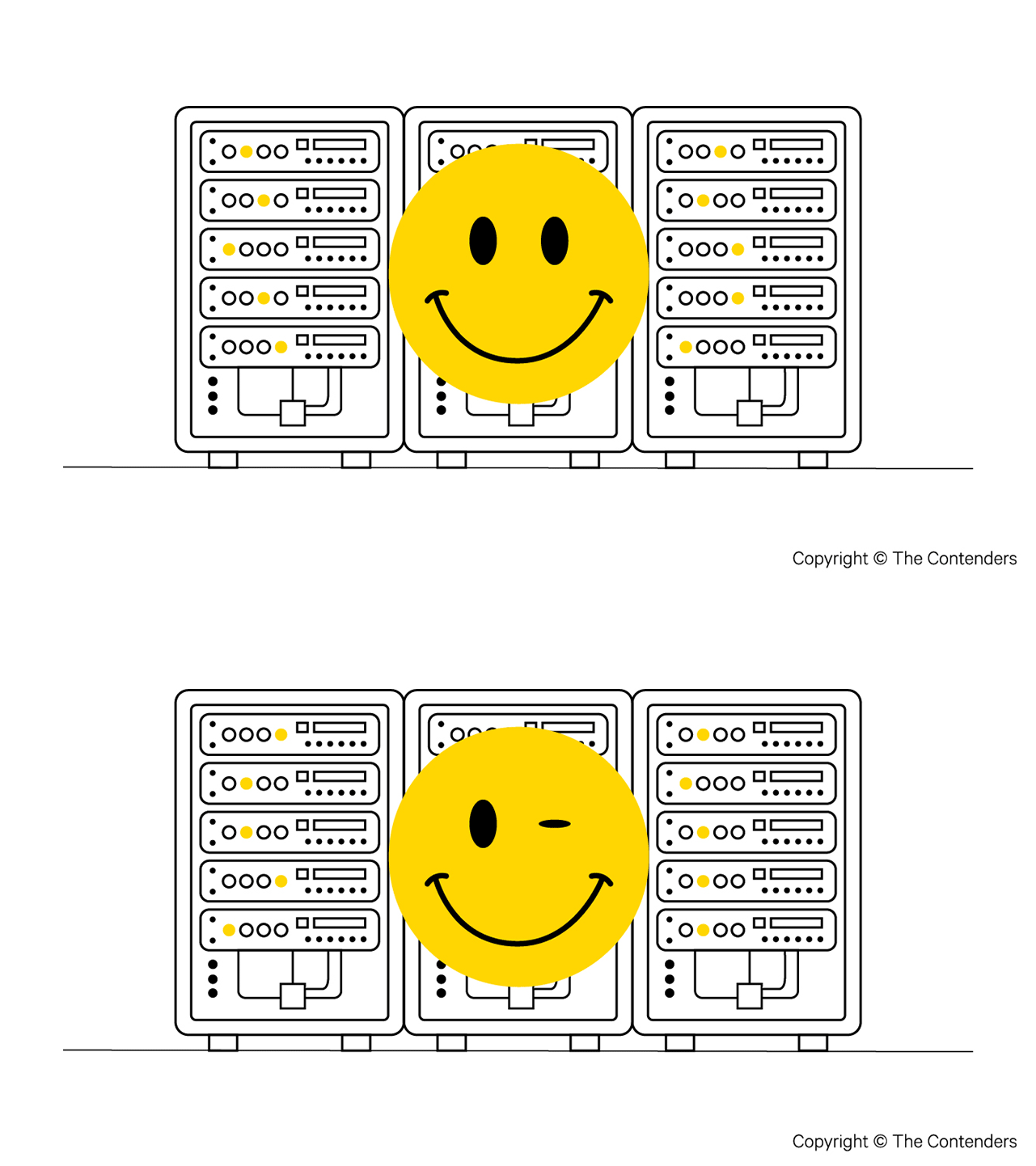
From a behavioural science perspective, this is pure emotional conditioning. Social media was built to trigger your amygdala by flooding your brain with cortisol through outrage or jealousy. Or even worse it would trigger an addictive dopamine response as your own echo chamber heaps praise on your post. AI arguably does the exact opposite, it self-calms the user by acting as a hyper personalised emotional mirror. We see already the early societal shifts toward this where the internal world becomes the place where people are turning to understand why something bothers them rather than shit-posting somewhere.
The branding trick is already seen. The friendly names and clean interfaces humanise a piece of cold code so effectively that we stop seeing it as an object and start connecting with it as an extension of ourselves. It is an asymmetric strategy that bypasses our critical filters by telling our egos exactly what they want to hear.
Taken to its conclusion this represents a tectonic shift in value creation. The dominant business playbook of the internet/mobile era was about scale and distribution network. Who could build the biggest warehouse or walled garden to trap the most eyes. The new imperative is grounded in pure consumer proximity. The winner of the AI era won't be the brand with the most reach, but the one that achieves singularity with its customers. Perhaps the new winning playbook will be expressed as becoming the trusted digital twin that manages the individual’s daily choices. Wherever it heads, the compass is pointing to a different world that will reward businesses that observe the best. It is a shift from whole-of-category to whole-of-customer. The moats are being dug closer to the heart than ever before.
From impressions to tollways
This isn’t just a shift in human psychology, it is starting to look like the complete demolition of the modern advertising based business model. Web 3.0 was and is an eyeball economy built on ad impressions and click arbitrage. We all optimised our brands for the scroll because the scroll generated cash. But when a consumer transitions their faith to an intimate digital twin, the traditional B2C channel of convincing disappears.
In this world your customer isn't just browsing search results or looking at display ads anymore; they are asking their AI partner in crime to book the flight, order the groceries, and choose the best insurance policy. The economic battleground shifts from buying space in the human head to paying an algorithmic toll to the AI whales controlling the agent interface. I reckon that is what is driving the cap ex spend by everyone from Google to Meta. They were all asset-lite low cap ex businesses until they themselves say this was an extensional winner take most moment. Gartner recently predicted that 40% of enterprise software applications will feature task-specific AI agents by the end of this year. Up from practically nothing eighteen months ago. AI is not another optimisation of your marketing tech stack; it looks like a transformation in who owns the access to the consumer. Welcome to the age of intimacy.
Branding the machine
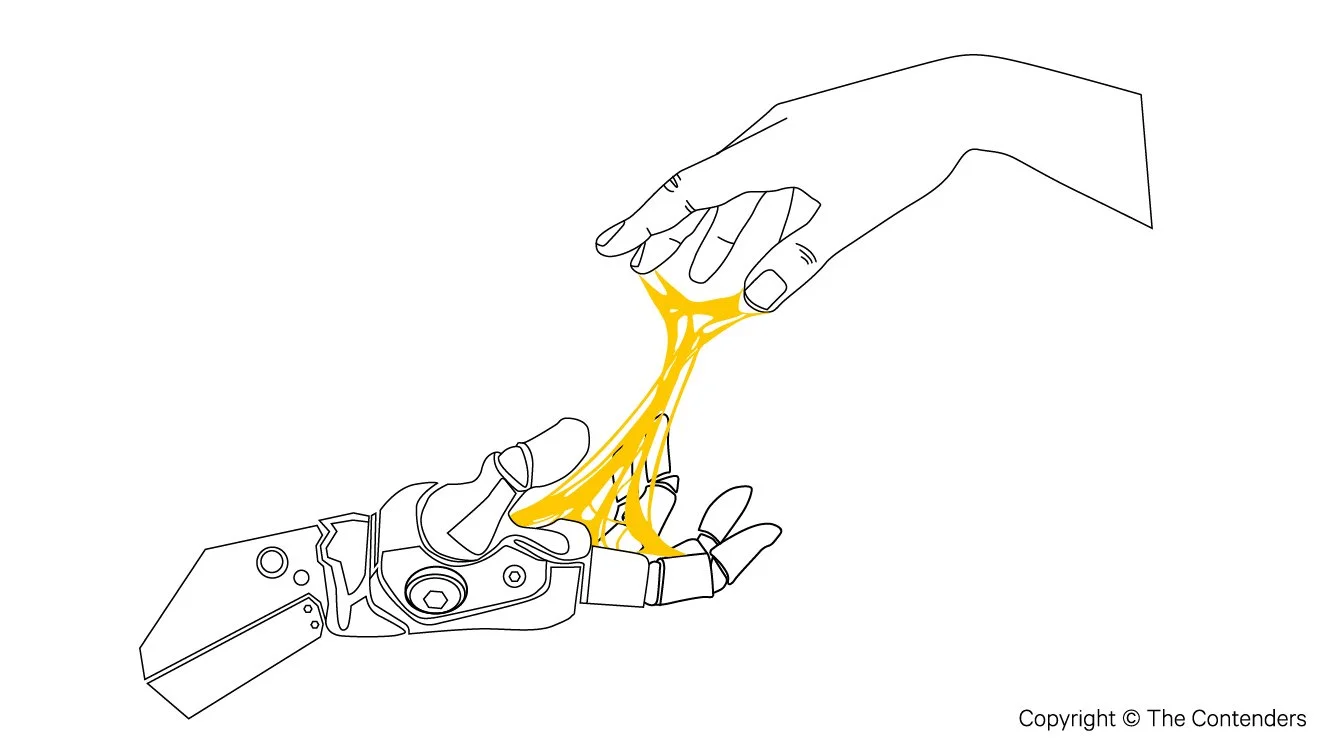
You can already see this play out in the brand language of the leading players. Nvidia aside they are not naming these systems Data Processor 5000, they are calling them Claude, Gemini and ChatGPT, names explicitly designed to evoke familiarity, trust and peer-to-peer relationships. We are wrapping an alien, power-hungry technology in the soft semiotics of human companionship because the creators know that the ultimate commodity isn't compute, it’s the feeling of being understood. We are casting these systems as our helpers and confidants, treating them with the emotional investment we used to reserve for our closest mates.
But like any gold rush, there is a massive shadow side to this synthetic sanctuary. Mass personalisation is quietly leading to mass alienation. When everyone has their own custom-tailored GPT feeding them an individualised subjective reality, our shared objective truth completely dissolves. We risk becoming a society of isolated nodes, perfectly comforted by our bespoke digital companions but entirely unable to tolerate the messiness of living with neighbours. The myth of Narcissus wasn't about vanity alone. He became so consumed by his own reflection that he lost the ability to engage with the world around him. Eventually, it destroyed him.
Beyond slop and fluff
Brands can no longer hide behind the soft goo of purpose statements or empty virtue signals. It is all about a point of view. If AI agents manage the transaction layer, human choice will be driven by deep emotional preference. Intimacy is what it says on the tin. It is the person who chooses to spend every day with you in spite of knowing your actual shit does stink.
This is counter to the slick sickening sea of sameness design trends of our day. To survive, your brand cannot just look polished on the outside; it must be good on the inside. My granddad always used to say that you can’t cut corners on the way to greatness and you certainly can't fake a real relationship. As we drift further into this automated world, the brands that win won't be the ones with the slickest prompts or the biggest model they will be the ones that remind us what it actually feels like to be human.
—
Be better to each other.